

The Weekly Wayfarer, Vol 12: First-Timer Italy & Honest Cruise Math
Your weekly boarding pass to better vacations (and fewer spreadsheets).
This Week: 🇮🇹 First-Time Italy, Done Right — and 🚢 the Honest Math of What a Cruise Really Costs, Plus the Labor Day Deals Still Standing ⭐
Inside: this week: 🌊 a first-timer's Italy playbook — how to pick a tour company, the classic mistakes to dodge, and what the trip realistically costs; 🌊 the cruise-fare autopsy — what the advertised price hides and whether booking through an advisor actually saves you money; 🧳 NCL's six-acre waterpark and a Philadelphia homecoming, Disney's return to New York, and a Princess deadline change that lands this week; ⭐ the Labor Day deals that survived the weekend, from genuinely free first-class air to Jamaica's comeback; 📩 and three trips from the booking desk that might sound suspiciously like yours.
Hello Wayfarers!
Somewhere in Rome right now, a first-time visitor is standing in the Colosseum line clutching a voucher for a "skip-the-line experience" that is, at this very moment, not skipping the line. The voucher was $89. The lesson is priceless.
This week's issue exists so that person is never you.
Our lead Deep Dive is Italy for first-timers — how to actually choose among the tour companies, what a realistic budget looks like, and the planning mistakes that turn the world's most beautiful country into a series of parking lots. The second dive tackles the question my inbox has been shouting all month: is booking a cruise through an advisor actually cheaper than doing it yourself? Short answer: the fare is the beginning of the price, not the end of it. Long answer inside.
Around those two: a genuinely busy travel-news week (Philadelphia gets a cruise homeport; a private island gets a waterpark), the Labor Day deals that survived Labor Day, and a look at what actually crossed my desk this week.
Pour something. Let's go.
✈️ The Pre-Flight Briefing
The flight plan is filed. Here’s your manifest of the deep dives, deals, and details landing in your inbox today.
In this issue:
- 🌊 Deep Dive: Your first Italy trip — tour company vs. DIY, the classic first-timer mistakes, and what it realistically costs
- 🌊 Deep Dive: The honest math of a cruise fare — what the advertised price hides, and whether an advisor actually saves you money
- 🧳 Caught in the Carry-On: NCL's six-acre waterpark and a Philadelphia homecoming, Disney returns to New York, a Princess deadline change, and why advertised airfares may be about to get less honest
- ⭐ The Deals: the Labor Day offers still breathing after the long weekend — free first-class air on luxury sailings, river savings worth banking for 2027, and Jamaica's comeback
- 📩 Connect & Book: three trips from the desk this week, and the easiest way to start yours
Got a destination in mind or not even sure where to start? Hit reply and let’s find a time to chat about your next adventure!
🌊 The Deep Dive
🥂 Your First Italy Trip: How Not to Do It Wrong
Everyone plans their first trip to Italy the same way: Rome, Florence, Venice, seven days, plus a quick swing down to the Amalfi Coast — as if the Amalfi Coast were a Walgreens you pass on the way home and not a five-hour logistics problem with a cliff attached.
I've watched this itinerary get built a hundred times. It always starts the same way, with a map and a feeling of infinite possibility, and it always ends the same way too: in a train station at 7 a.m., dragging a suitcase across cobblestones laid in 1400 by a man with a personal grudge against wheels.
Here's the thesis, and I will defend it in linen: your first Italy trip is not a coverage problem. It's a depth problem. Fewer bases. Better lunches.
The sprint is the mistake
The Rome-Florence-Venice sprint looks efficient on paper because paper doesn't carry the luggage. Every hotel change costs you roughly half a day — pack, check out, transfer, wait for the room, reorient — so a seven-day trip with four bases quietly spends two of its days in transit. You bought a week of Italy and booked three days of it, plus an unpaid internship in Italian rail logistics.
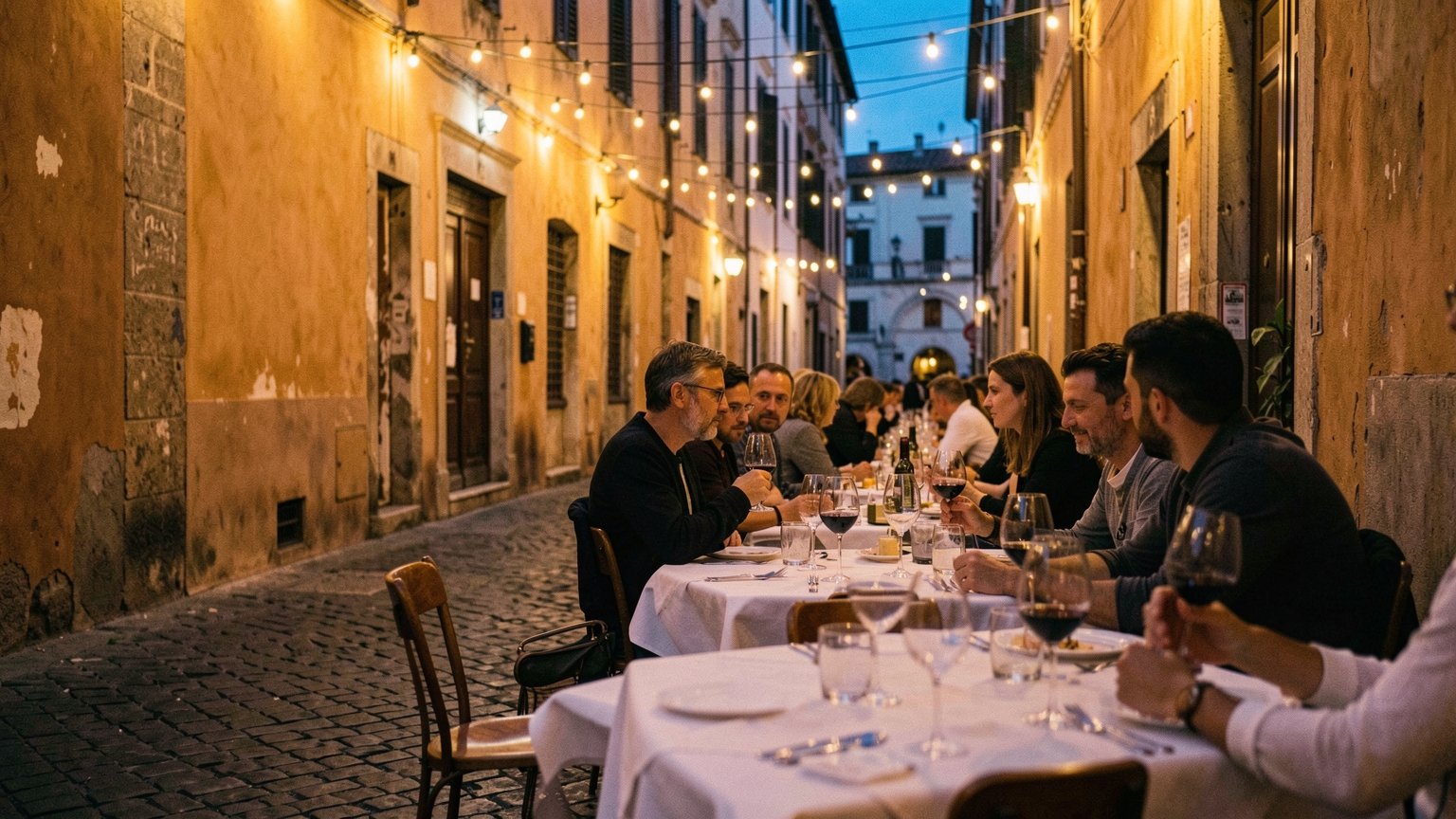
And what the sprint skips is the entire point of the country. Rome at seven in the evening does a thing no checklist captures: the light turns amber on the ochre walls of Trastevere, the swifts start looping over the rooftops, and every table in the street fills with people who have decided, correctly, that nothing else needs to happen today. Order the cacio e pepe — Roscioli, near Campo de' Fiori, serves a version that will quietly rearrange your standards — and stay until the waiter stops checking on you, which in Rome is a compliment. That hour is the trip. The sprint schedules right over it.
Guided, DIY, or the hybrid nobody names
There are three ways to run this. A fully guided tour — the Globus, Collette, and CIE Tours end of the market — earns its price in specific situations: it's your first time in Europe, you refuse to think about a single train ticket, you're bringing parents whose idea of adventure now includes a handrail, or the forty hours you'd spend planning bill out at more than the tour costs. A good escorted tour isn't a cop-out. It's outsourcing, and you already believe in outsourcing.
Full DIY is the second-trip move, once you know which Italy you're actually chasing — the food one, the art one, the sit-in-a-piazza-and-judge-pigeons one.
The hybrid is what most of my first-timers actually end up with, and almost nobody walks in asking for it: independent bases and unhurried days, with the high-stakes moments professionally handled — early access at the Vatican Museums so you meet the Sistine Chapel with dozens of people instead of thousands, a guide in Florence who walks you through the Uffizi in two focused hours instead of four shuffling ones, a driver for the hill towns so nobody has to learn what an Italian traffic-camera fine is the hard way. You keep the freedom. The friction gets removed. (The tours and guides worth having here are bookable — talk to me about that rather than gambling on whoever bought the best ad.)
The budget has opinions
The internet is currently asking, in measurable search volume, whether $1,000 is enough for a trip to Italy. I admire the optimism. That figure is roughly the airfare — sometimes it's just the airfare — and the budget will spend the rest of the trip reminding you of the difference.
A realistic first-timer budget carries the four lines everyone remembers — flights, hotels, food, trains — and a fifth line almost nobody plans for: the reservation economy. The marquee sights in Rome and Florence increasingly run on timed advance entry, and the wing-it plan now ends in either "sold out" or a markup with a lanyard. Budget the bookings. Budget the coperto — the small cover charge that startles every American exactly once. And budget one meal per city you'd flinch at back home. You will never regret the meal. You will absolutely regret the fourth city.
Fewer bases, better lunches
The playbook: pick two bases for a week — Rome and Florence is the classic, and it's a classic for a reason — and let the trains bring Italy to you in day-trip form. From Florence, Bologna is about thirty-five minutes away and will feed you tagliatelle al ragù like it's settling a bet; grab a schiacciata from All'Antico Vinaio before your train and eat it on the platform like a local with priorities. From Rome, Orvieto sits an hour north on a volcanic plug, with a striped cathedral and afternoons that seem to run longer than they do anywhere else.

Give Venice its own trip, or give it two honest nights — enough for a spritz and cicchetti standing at Cantina Do Mori, a bacaro that has been pouring wine since the 1400s, and a quiet morning in Cannaregio before the day-trippers land. Venice deserves better than being your layover.

The Amalfi detour? Save it. It's a destination, not an errand.
If a first Italy trip is on your radar — and the 2027 tour season is already open for business — the smart move is choosing which of these three models fits you before you fall in love with an itinerary that fits none of them. That's a twenty-minute conversation. I'm easy to find.
🥂 The Honest Math of a Cruise Fare

A cruise fare is not a price. It's an opening bid.
And this week, the rest of the travel industry decided its own opening bids should get less honest, which makes it a very good week to explain how cruise pricing actually works. The Department of Transportation has proposed rolling back the full-fare advertising rule — the regulation that currently forces airlines to advertise the number you'd actually pay, taxes and fees included, rather than a decorative one. United, meanwhile, is slicing Polaris and Premium Plus into tiers, so the business-class seat you thought you understood now comes in editions, like a video game. Advertised prices across travel are drifting away from final invoices at precisely the moment the loudest rising questions in cruise search are: what's the cheapest way to book, is a travel agent actually cheaper, what are the hidden fees — and, at genuinely impressive volume, what is the $99.75 charge?, typed by thousands of people staring at a credit card statement like it owes them an explanation.
So let's do the honest math. Slowly. With every course on the table.
The fare is the appetizer
Start with what the advertised fare genuinely buys, because it's real: the cabin, the ocean, most of your meals, the shows, the pools, a crew that somehow knows your name by day two. Judged as a nightly rate against any decent resort, it's hard to beat. But the fare is the appetizer, and the kitchen has more courses planned.
Taxes, port charges, and government fees arrive first, materializing at checkout like a plot twist you technically should have seen coming. Then the daily service charge — the automatic gratuities — added per person, per day, for every day of the sailing, compounding quietly in the background like interest with a smile. Then the modern menu of everything the mass-market fare has learned to exclude: drinks beyond the basics, Wi-Fi, specialty dining, shore excursions, and the embarkation photo in which you look faintly like a hostage.
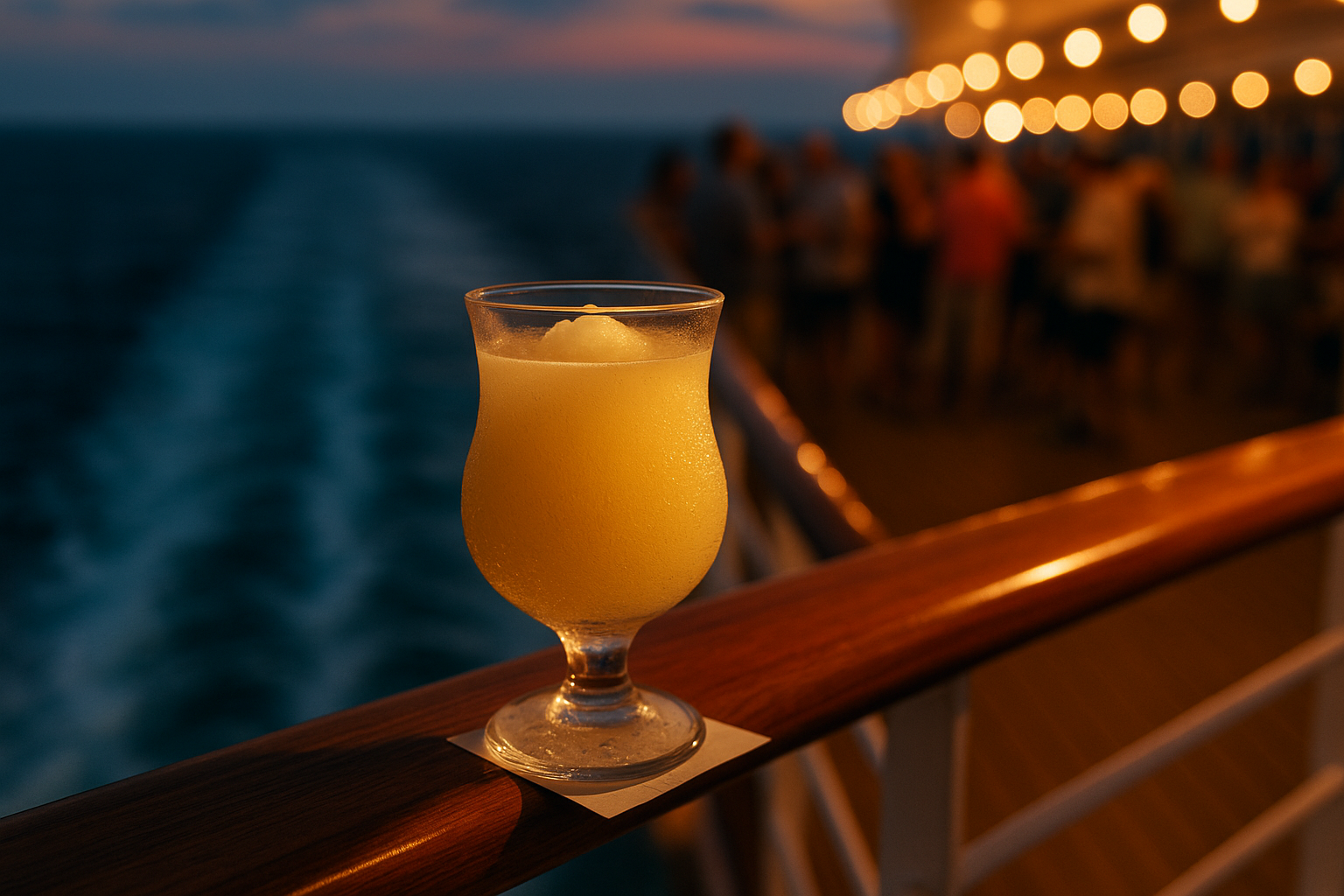
You feel the mechanism most clearly on the first afternoon at sea. The teak rail is warm under your hand, the wake is unspooling behind the ship in two white lines, someone three loungers down has already committed to a nap of real ambition — and a cheerful person appears at your elbow with a frozen drink the color of a sunset and a slip of paper to sign. The drink is wonderful. The slip is the point. You'll sign a version of it eleven more times before you've finished the first sip.
None of this makes cruising a bad deal. It makes the advertised fare a bad forecast. Those are different problems, and only one of them can be fixed at booking.
Same fare, different everything
The part that surprises people trained by airline pricing: for the most part, cruise lines hold price parity. The same sailing, the same cabin category, runs at essentially the same fare whether you book on the line's own website, through a giant online travel seller, at the warehouse club where you buy your tires, or with an advisor. (Yes, people genuinely ask whether they should book a cruise where they buy tires. It's a fair question. The rotisserie chicken has earned a certain amount of trust.)
So “where's the cheapest place to book” mostly answers itself: everywhere, and nowhere. What actually differs is everything attached to the fare — which perks come with it, whether anyone does the all-in math with you before you commit, and, the part no comparison site prices, who is watching the booking in the long quiet stretch between your deposit and your sailing date. The better question was never “who has the lowest fare.” It's “what will this trip actually cost me, all in — and who's minding it while I get on with my life?”
What an advisor actually changes
The blunt answer to “is an agent cheaper”: booking through an advisor generally costs you nothing extra, because the cruise line pays the commission out of the same fare you'd have paid anyway. You are not buying a markup. You're claiming a service that's already built into the price — which most people gallantly decline, the way you might decline a free dessert out of politeness.
Where that service shows up is in the math and the watching. The math: whether the drink package pencils out for how you actually drink, whether the balcony is worth it on this itinerary or is just a lovely place to store wind, whether the “cheap” inside cabin is cheap or merely small. The watching: on most ocean lines, final payment lands roughly 90 to 120 days before sailing, and the stretch between deposit and that deadline is when fares move. Fares behave like indoor cats — stationary for weeks, then suddenly somewhere unreachable at 3 a.m. for no stated reason. When one drops before final payment, there is often something to be done about it — a repricing, an upgrade, a credit, depending on the line's rules — but only if someone notices in time. Noticing is literally my job.
None of this requires you to book through me. If you like driving the search yourself, drive it — gnttravelpros.com is open all night and doesn't judge. But if a cruise is on your radar this fall, bring me the ad with the suspiciously beautiful number on it. We'll add the courses the appetizer didn't mention, and you'll know what the trip really costs before you sail — instead of finding out on the statement afterward, ninety-nine dollars and seventy-five cents at a time.
🥂 When “Free” Is Real: Luxury Cruising’s Free-Air Moment

The most expensive part of your luxury cruise might be the part you haven’t priced yet.
Not the suite. Not the wine pairing. The flights — the ones you’ll book last, six weeks out, after every decent premium seat to the far corners of North America has been claimed by people more organized than you. I watch smart, spreadsheet-owning professionals do this every single season, and every season the air bill arrives like a plot twist nobody bothered to foreshadow.
The far corners fight back
Luxury itineraries have a habit of starting in places your airline considers an inconvenience. Alaska sailings love a one-way routing — fly into one city, sail a week, fly home from another — which means two one-way premium fares, which is airline-speak for “we’d like a word with your savings.” Canada & New England in autumn is worse: everyone with a camera and a sweater wants in during the same six-week window the leaves have agreed to perform. The cruise fare you can plan around. The airfare plans around you.
And the performance deserves the audience. Stand at the rail as the ship eases past Peggy’s Cove, the lighthouse white against granite the color of wet slate, gulls arguing over the wind, the whole coast smelling of salt and spruce — and the airfare argument goes quiet for a while. Later, in Bar Harbor, there is a lobster roll with your name on it, eaten on a wharf while the fog auditions for the evening. This is what you’re buying. The air is just the toll booth in front of it.
An adjective never bought anyone a seat
So here’s the literacy test for every “free” you’ll ever read: does it come with nouns? A real inclusion names a class of service, a set of sailings, a window with dates in it. A fake inclusion names a mood — “elevated,” “curated,” “signature.” A signature is what you give the delivery driver. If the best thing in the fine print is an adjective, you’re not reading an offer; you’re reading a horoscope.
Real inclusions are rare for a boring reason: they cost the cruise line actual money. Which is exactly why the genuine article deserves your attention when it appears.
Exhibit A
Regent Seven Seas has just launched Free First-Class Air on 35 select voyages spanning Alaska, the Caribbean, and Canada & New England, bookable September 1 through October 31, 2026, with companion air savings in the $1,500–$2,000 range stacked alongside.
Apply the test: class of service, named. Sailings, countable. Dates, real. Two of the three regions are precisely where premium air does its worst damage — this offer is aimed at the pain point, not scattered at random. That’s what a real inclusion looks like when it’s dressed for work.
And what first class buys on those long hauls isn’t vanity. It’s the lie-flat seat, the nap over the mountains, and arriving in the embarkation city rested enough to enjoy day one instead of donating it to recovery.
Maybe you were just on the wrong ship
One more group this moment belongs to: the people who tried cruising once, on a ship with a go-kart track and eleven thousand of their closest strangers, and swore off the whole idea. Fair verdict. Wrong trial.
A small luxury ship is a different animal entirely. In Alaska, it slips into fjords the mega-hulls can’t touch and gives you Juneau with enough daylight left for the Mendenhall Glacier, sitting in its valley like something the ice age forgot to take home. Suites instead of cabins, a crew that learns your name by Tuesday, and no line for anything, anywhere, all week. Dinner is a table that remembers you, not a buzzer. If your first cruise felt like a mall with a wake, you didn’t experience the category — you experienced its opposite.
Whether one of those 35 sailings actually matches your dates — and whether free first-class air from your particular home airport beats another line’s math once everything’s counted — is exactly the kind of question I like being asked. Ask it before you book the version that looks right and flies expensive.

⭐ The Wayfarer's Favorites (The Deals)
Rates are subject to availability and change until booked. Supplier terms and conditions apply
Labor Day sales have the lifespan of a fruit fly. These six made it past the weekend — and each one comes with the judgment call, because a price without a 'who is this actually for' is just a number in a costume.
Regent Seven Seas — free first-class air, and they mean it.
Regent is putting FREE first-class air on 35 select Alaska, Caribbean, and Canada & New England voyages for bookings made September 1 through October 31.
The Edge: on a luxury itinerary, the flight is the line item that quietly ruins the spreadsheet — premium-cabin air to Anchorage can rival a cruise deposit all by itself. When the air is genuinely included and genuinely first class, the all-in math changes class entirely. This is the rare 'free' that behaves like the word means something.
MSC Cruises — the family-math rewrite.
MSC's Labor Day Sale runs up to 40% off with up to $400 onboard credit and Kids Sail Free, through September 7.
The Edge: Kids Sail Free is the piece that actually moves a family-of-four budget — the discount headlines get the attention, but zeroing out two fares is what changes the answer. Best fit: families comparing a cruise against a land all-inclusive and wondering why the cruise keeps losing on paper. Run it again with the kids at zero.
Virgin Voyages — the per-night number that's more honest than most.
Virgin's Semi-Annual Sale offers $99 per night or up to $400 in onboard credit, through September 7.
The Edge: adults-only, and Virgin's fare already bakes in essentials many lines sell back to you piece by piece — which makes per-night framing here less of a magic trick than it usually is. Best for couples who want a ship without a kids' pool and without a fee ambush.
AmaWaterways — buying next year's water at this year's sale.
Ama's Labor Day offer runs up to $2,500 per stateroom plus $250 onboard credit, through September 15.
The Edge: yes, Europe's rivers are low this season — see the Carry-On — which is precisely why a 2027 river booking made now, with a line whose low-water playbook is battle-tested, is the calm person's move. Patience, subsidized.
Sandals — the Great Jamaica Comeback.
Up to $1,500 in credit, $350 toward air, and a free Jamaican adventure across three reimagined Jamaica resorts, through September 7.
The Edge: freshly reimagined properties are the sweet spot of resort travel — new rooms, new restaurants, pre-hype pricing. And Jamaica rewards leaving the resort at least once: a roadside plate of proper jerk from a smoke-blackened pan somewhere on the north coast will recalibrate your understanding of chicken. Ask me where I send people.
Beaches Resorts — Endless Summer for the whole crew.
Up to $1,000 in credit, $750 toward air, and a free catamaran cruise, through September 7.
The Edge: this is the family all-inclusive play where the extras that usually nickel you — the sail, chunks of the airfare — arrive pre-paid. Fits multigenerational groups where three generations need three different definitions of 'vacation' under one roof.
One housekeeping note: several of these run on booking codes, and you will never see a code in this newsletter — on purpose. The deal descriptions are yours; the booking mechanics are mine. Reply to this email and I'll apply whatever applies. That's rather the point of me.
🔎 Quick fine print: Terms, conditions, and availability apply. Offers can change (or sell out) fast—so we’ll always confirm the exact promo and rules for your dates before you book.
🧳 Caught in the Carry-On (Tosh's Takes)
Norwegian had the kind of week where you check if they're okay. In one breath: Great Tides Waterpark opened at Great Stirrup Cay — nearly six acres of slides on a private island that used to be a beach with a barbecue — NCL announced it's homeporting in Philadelphia, the first cruise line to do so in 15 years, and Free at Sea specialty dining now applies to every guest in the cabin, not just the first two. Tosh's take: Philadelphia is the sleeper here. A drivable homeport changes the math for the entire mid-Atlantic — no flights, no pre-cruise hotel, no airline holding your vacation hostage. If you live between Baltimore and North Jersey, your cruise options just got a new zip code.
Disney Cruise Line is returning to New York in 2027, with fall 2027 and spring 2028 itineraries. Take: Disney inventory out of NYC historically behaves like concert tickets. If your family is even Disney-curious, this is a talk-to-me-early situation, not a wait-and-see one.
Princess changed its final-payment and deposit rules, effective September 2. Not glamorous. Extremely relevant. Take: final-payment dates are where good trips go to die — most lines want your balance roughly 90–120 days out, and the outliers run from 60 days to well over a year. If you booked Princess before this week, ask what changed for your specific sailing. It's a two-minute question that prevents a very bad afternoon.
The DOT proposed rolling back the full-fare airline advertising rule, and United is moving to tiered Polaris and Premium Plus fares. Take: translation — the advertised airfare may soon tell you even less than it does now, and premium cabins are being sliced into sub-cabins with their own fine print. The gap between the price you saw and the price you paid is where this newsletter earns its keep.
Europe's rivers are low. The Danube and Rhine are running shallow, Riviera paused sales on some affected dates (paused, not cancelled), and Portugal capped cruise-ship numbers on the Douro. Take: this isn't a reason to avoid river cruising — it's a reason to book it with someone who reads water levels the way other people read box scores. The right itinerary in the right season sails straight past the problem.
📩 Connect & Book
From the desk this week — names withheld, lessons free:
The Italy maximalists. A couple planning their first Italy trip arrived with twelve days and a spreadsheet featuring nine cities, two of which they could not confidently place on a map. We rebuilt it around two bases — Rome and Florence — and let day trips do the sprawling. Same twelve days. Half the train platforms. They now have time to eat lunch sitting down, which in Italy is arguably the entire point of the country.
The fare-grid family. A family of four had the 'cheapest' cruise fare sitting in a cart, ready to click. We ran the all-in numbers side by side — fees, gratuities, the extras they'd actually buy on board — against a modestly higher fare with more baked in. The cheap one lost. It usually does. That comparison took twenty minutes, and it is, in miniature, the whole reason advisors exist.
The river realists. Empty-nesters wanted a fall river cruise, read the low-water headlines, and nearly shelved the whole idea. Instead: a 2027 sailing, locked in while the river lines are feeling generous, with a line whose low-water playbook we trust. Next year's Danube, this year's terms.
If any of that sounds like your situation, three easy paths: reply to this email, browse and book directly at gnttravelpros.com, or grab a planning call if you'd rather talk the tradeoffs through first. Advice when you want it. Self-serve when you don't.
Places change — hours, menus, and whether a spot still has its magic. Worth a quick confirm before you go, or let me handle the details.
Join the Crew
Prefer to plan it yourself? Search over 13,000 cruises and book your entire trip at gnttravelpros.com 24/7.
Want someone else to handle the logistics? That’s what we’re here for.
Follow along for just enough travel FOMO to finally make you book that trip. Your “Out of Office” reply is waiting!
✨ Win a $10,000 vacation: Choice of a cruise, a Europe journey, or a resort stay. Enter here: https://go.gnttravelpros.com/vacation/deals/promos/contest-enter-to-win. No purchase necessary. See site for full rules.
🛒💻 Prefer to be your own captain? You can browse and book your entire trip yourself, any time — the same deals, on your schedule.
Connect with us:
🌐 Web: gnttravelpros.com
📸 Instagram: @gnttravelpros
👍 Facebook: facebook.com/GNTTravelPros
💼 LinkedIn: GNT Travel Pros - Dream Vacations
▶️ YouTube: @gnttravelpros
📍 Find us on Google: GNT Travel Pros on Google
⭐ Loved working with us? Leave us a Google review
Reach Us:
📞 Text/Call: (954) 220-TRVL (8785)
📅 Schedule a Chat: calendly.com/tjunior-dreamvacations/travel-consult
✉️ Email: tjunior@dreamvacations.com
Happy Wayfaring!
--Tosh R. Junior, CTA | Owner & Head Travel Pro, GNT Travel Pros – Dream Vacations ✈️
Have a trip in mind?
Let's turn this into a plan. A free consultation is the fastest way to get started.
Schedule a Free Consultation