

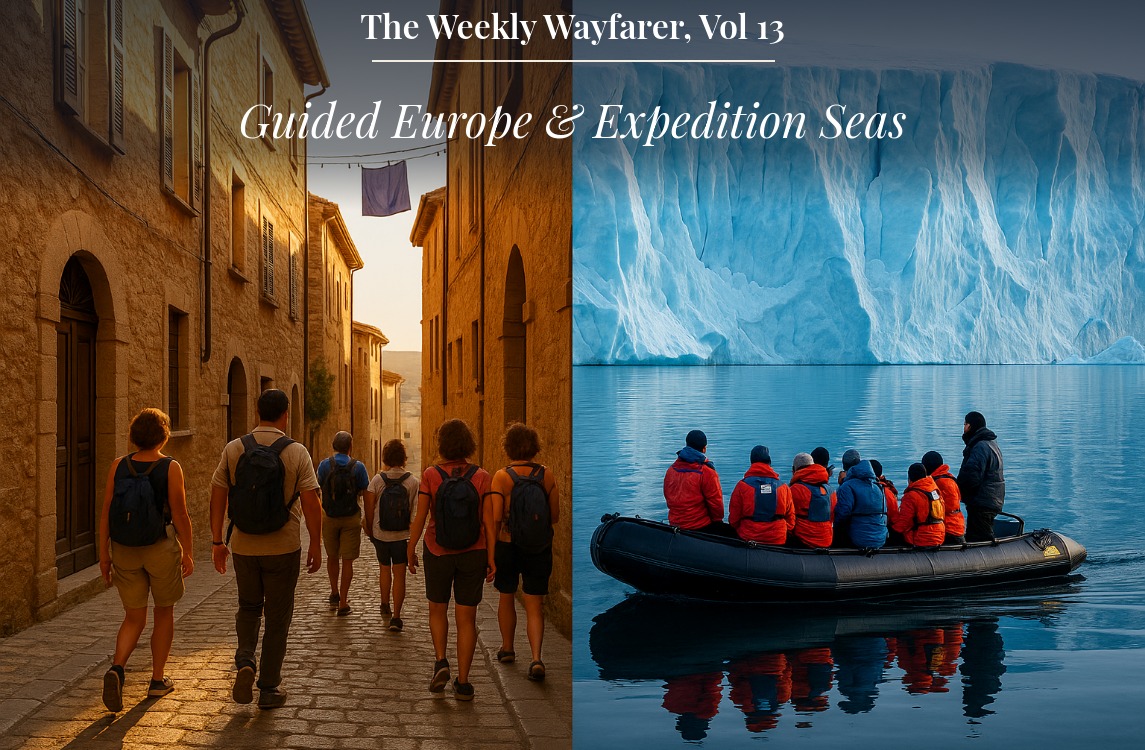
The Weekly Wayfarer, Vol 13: Guided Europe & Expedition Seas
Your weekly boarding pass to better vacations (and fewer spreadsheets).
This Week: 🚌 Two fronts this week: how to choose the right escorted tour of Europe — tiers, pace, and the 'average age' question, answered honestly — and the small-ship expedition world built for people who swear they hate cruises 🚢. Woven through: TSA's gate-side comeback ✈️, a September deal board with actual deadlines ⭐, and three trips that crossed my desk 📩.
Inside: 🌊 Deep Dive one: choosing a European escorted tour company — Saver vs. Classic vs. Premium, group size, walking pace, and what the big Trafalgar consolidation means for your 2027 plans. 🌊 Deep Dive two: expedition and small-ship cruising — the category quietly winning over solo travelers, families, and confirmed non-cruisers. 🧳 In the Carry-On: TSA lets non-flyers back to the gate, your Global Entry app gets a new name, an Amex cruise-perk deadline, and a calm word about river water levels. ⭐ The Deals: six deadline-verified offers across tours, river, cruise, and luxury — each with the judgment call attached. 📩 Connect & Book: three real decisions off my desk this week.
Hello Wayfarers!
This week's issue is about one deceptively simple idea: being guided well. Three features, one thread. First, how to choose an escorted tour of Europe without marrying the wrong bus — tiers, group sizes, pace, and the average-age question you've been too polite to ask out loud. Second, the case that expedition cruising was built for people who hate cruises (I have the survey to prove it). Third, Italy for first-timers: the tour, the mistakes, and what it actually costs — with the seven-city fantasy lovingly reduced to three.
Also aboard: airport news that's genuinely useful for once (the TSA is letting non-flyers back to the gate, and your Global Entry app changes its name on September 15 — more on both below), a deals shelf where every deadline is real, and three stories from this week's desk.
Pour something. Let's board.
✈️ The Pre-Flight Briefing
The flight plan is filed. Here’s your manifest of the deep dives, deals, and details landing in your inbox today.
In this issue:
- 🌊 The Deep Dives: How to choose an escorted tour of Europe — tiers, group size, pace, and honest brand-matching · Expedition cruising for people who hate cruises — the Galápagos, Antarctica, and why Japan is next · Italy for first-timers — the triangle, the three mistakes, the real cost
- 🧳 Caught in the Carry-On: TSA's Gateside gate passes, the Trusted Traveler app switch (Sep 15), cruise-line product shuffles, and calm words about European river levels
- ⭐ The Wayfarer's Favorites: Six deals across cruise, river, tour, luxury, and resort — every one with a real deadline and an advisor's read
- 📩 Connect & Book: Three stories from this week's desk, and how to get on my calendar
Got a destination in mind or not even sure where to start? Hit reply and let’s find a time to chat about your next adventure!
🌊 The Deep Dive
🥂 How to Choose an Escorted Tour of Europe (Without Marrying the Wrong Bus)
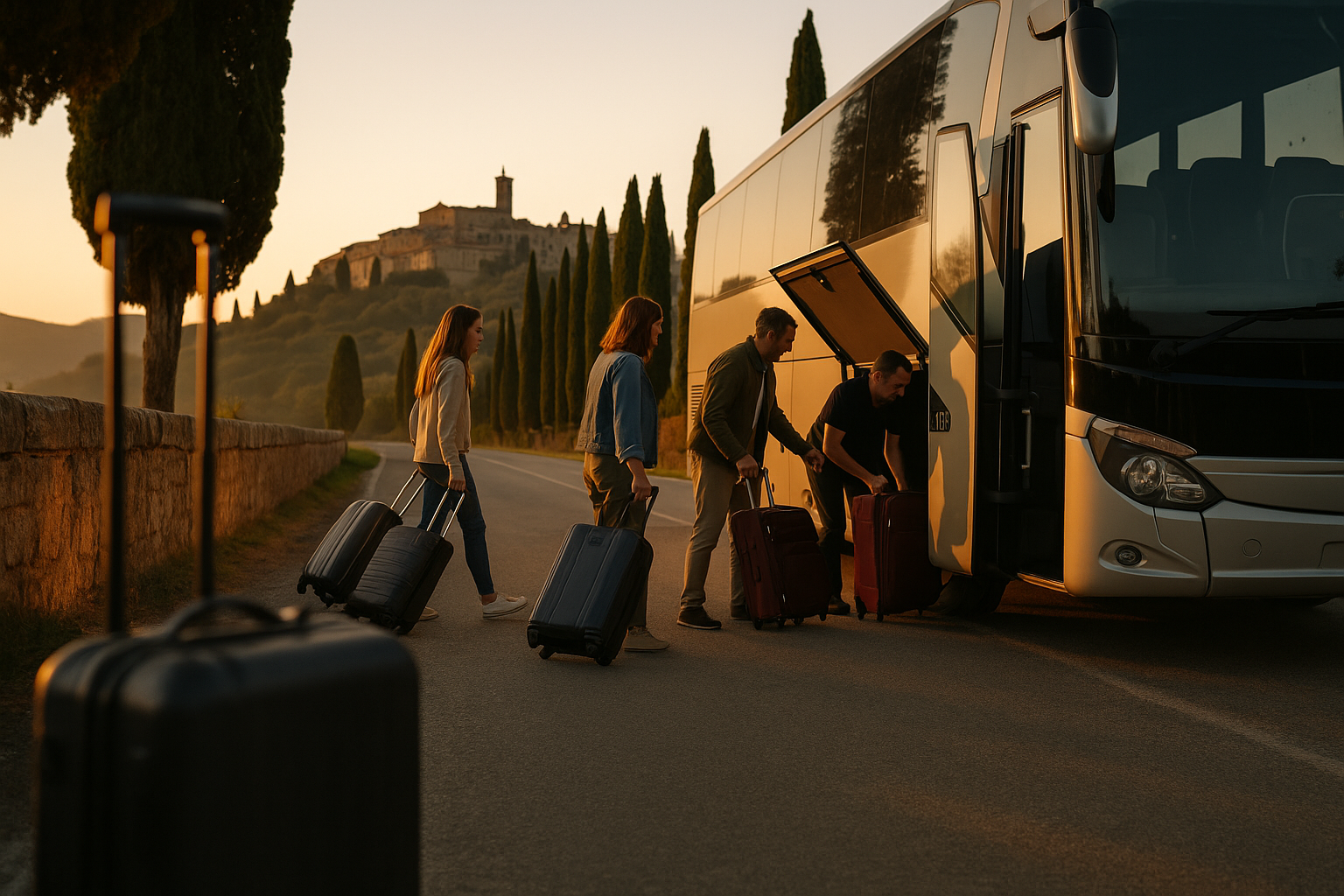
Nobody falls in love with a bus.
And yet every year, thousands of otherwise careful people commit to ten days on one with forty strangers, sight unseen, on the strength of a brochure photo of a couple laughing at a vineyard. That is not booking a vacation. That is an arranged marriage with a luggage allowance.
I say this with love, because escorted touring — done right — is one of the great cheat codes of European travel. Someone else drives, someone else carries, someone else has already argued with the hotel about the rooms. You just show up and have Tuscany happen to you. The trick is the "done right" part, and this is the exact moment to learn it, because the category just did something it almost never does: it simplified.
The Travel Corporation is retiring Insight Vacations and Costsaver and folding its guided-travel portfolio into a single Trafalgar power brand — more than 600 itineraries across 75 countries, sorted into three tiers: Saver, Classic, and Premium. Two fewer logos on the shelf. Which sounds tidy, and mostly is. But when brands consolidate, the differences between them don't disappear — they move into the fine print. The choosing didn't get easier. It just got quieter.
The tier is the trip
Here's what a tier actually buys, across the industry, in every brochure ever printed: where you sleep, what's included, and how much of your day is already spoken for. That's it. That's the whole game.
A saver-tier tour and a premium-tier tour can visit the same cities in the same order and be entirely different vacations. On one, the hotel is a fifteen-minute coach ride from the center, dinner is "at leisure" (translation: you're buying it), and the included experiences are the ones with parking. On the other, you're sleeping inside the old town, half your dinners are handled, and the experiences are the kind with a locked door and a person with a key. Neither is wrong. But the brochure prints the price difference in large type and the life difference in six-point font, and travelers keep buying the large type.
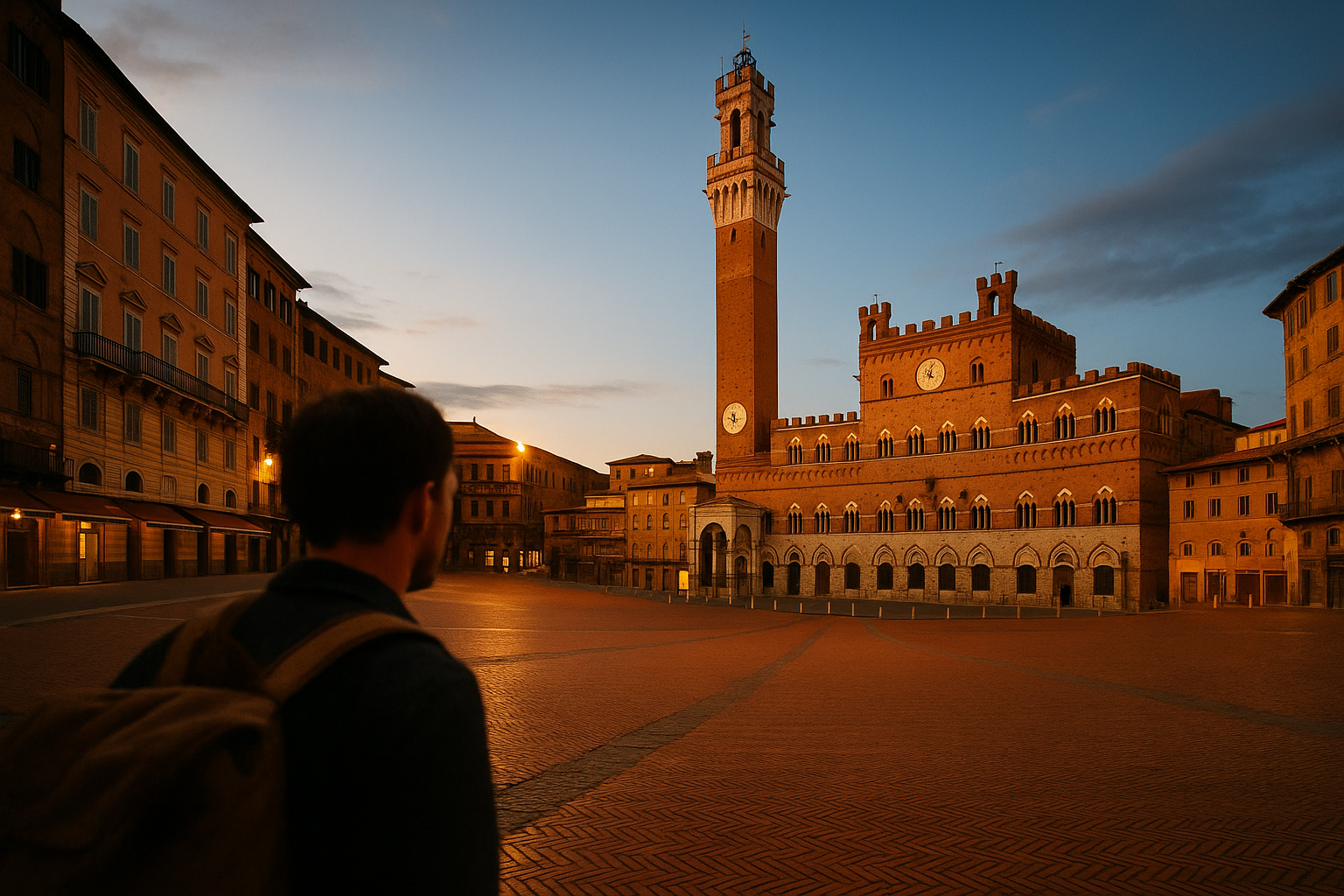
The test I give clients: picture your afternoon in Siena. On the right tour, you're standing in the Piazza del Campo at six in the evening, when the day-trippers have drained away and the brick bowl of the square goes the color of cognac, and your hotel is a five-minute walk uphill. On the wrong tour, you saw the Campo at noon for fifty minutes, with a meeting point. Same city. Same checklist. Not the same trip.
Group size is a personality test
A forty-person coach moves through Europe like a well-organized glacier: majestic, unstoppable, and never, ever nimble. That's not an insult — it's physics. Big-group touring is how the greatest-hits itineraries stay affordable, and for a first-timer who wants Rome, Florence, and Venice stitched together without making a single logistics decision, it's honestly hard to beat.
But notice what Trafalgar itself just did: launched and expanded Small Group Tours for 2027. The industry is telling you where the demand went. Small groups fit through the doorways that make Europe worth the flight — the family-run trattoria that seats eighteen, the centuries-old cellar in Orvieto carved into the tufa beneath the town, the walking pace that lets you actually stop when something smells like it should be investigated. A big coach sees Europe. A small group gets let inside it.

Know which traveler you are before you book, because the bus will not adapt to you. The bus has a schedule. The bus is very serene about this.
The question everyone whispers
"What's the... average age?" Clients ask it like they're confessing something. Relax — it's the single most useful question in guided travel. You're just asking the wrong document.
The honest answer is that age varies wildly by brand, tier, itinerary, and season, and no sales rep is handing you a demographic breakdown anyway. But the itinerary will tell you everything if you interrogate it. Count the hotel changes. Count the 7:30 a.m. departures. Count the free afternoons. An itinerary with six one-night stops and a wake-up call every morning has told you the energy level of the group better than any survey ever could — and an itinerary with two-night stays and whole unscheduled afternoons has told you the opposite. Pace is the real demographic. Read the schedule, not the stock photos.
Do the math before the bus does it to you
Now, the DIY case: yes, you can absolutely research all of this yourself. Tier by tier, brand by brand, across a category that just reorganized itself mid-sentence. I know people who enjoy that. I also know people who alphabetize their spice racks.
Here's what an advisor actually changes. One: matching — the brand-and-tier fit above is pattern recognition from watching real travelers come home happy or not, and it's the difference between a good tour and the right one. Two: timing. Tour operators reward early commitment on next-year departures, and the windows are real.
Right now, for example, Globus is running its Freedom to Travel savings — $300 to $1,200 per couple on 2027 tours, with a booking window through October 12.
That's not urgency theater; that's how the category prices patience. And three: it typically costs you nothing extra to have someone in your corner when the itinerary changes — which, in Europe, is a when.
If a 2027 Europe tour is anywhere on your radar, the smart move is a twenty-minute conversation before you commit to the bus. Reach out, or start poking around at gnttravelpros.com. Marry well.
🥂 Expedition Cruising Is for People Who Hate Cruises
"I don't do cruises."
I hear this weekly — usually from someone who then spends ten minutes describing, in loving detail, exactly the trip an expedition ship was built to deliver. Small group. Wild places. No buffet line. No belly-flop contest. They don't hate cruises. They hate a very specific cruise that lives in their head, and it has a wave pool.
Here's the part the industry just said out loud: the inaugural Travel Advisor Pulse survey named solo travelers, families, and confirmed non-cruisers the biggest opportunity in expedition cruising. Read that again. The category's growth market is people who swore off the category. That's not a marketing problem. That's a labeling problem.
The word "cruise" is doing all the damage
When someone tells me they hate cruises, what they actually hate is the megaship sea day: five thousand people, a pool deck DJ at volume eleven, an art auction they were never planning to attend, and a daily program with the emotional range of a casino. Fair. That's a floating resort, and floating resorts are wonderful for people who want floating resorts.
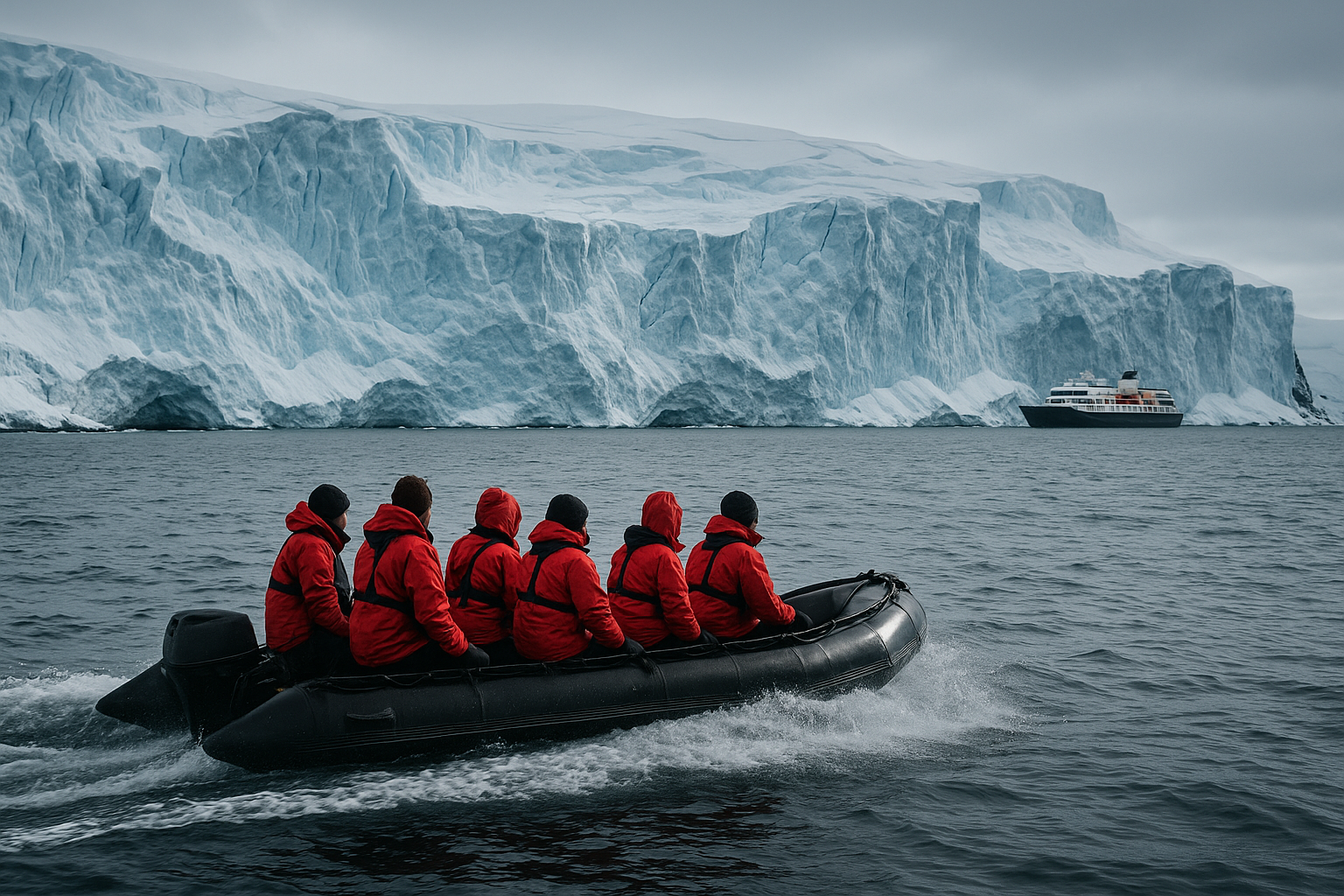
An expedition ship removed all of it. There's no casino, no climbing wall, no production of Grease. There are roughly 100 to 200 passengers, a fleet of zodiacs strapped to the deck like the ship's actual personality, and a team of naturalists who have never once been asked to run bingo and would not survive the request.
The ship isn't the vacation. The ship is the basecamp that happens to have excellent wine.
A zodiac day is nothing like a sea day
Here's what the morning actually feels like. The expedition leader's voice comes over the PA around 6:30 — conditions, landing site, which layer system you'll regret skipping. Down in the mudroom you step into boots still cold from yesterday, and then the zodiac drops off the ship's flank and slaps across water the color of gunmetal, and somewhere between the ship and the shore the entire concept of email quietly dies.
Then the driver cuts the engine near a glacier face and you sit there in a silence so complete you can hear the ice tick and crack like something enormous thinking. Nobody talks. Not because someone asked — because the landscape did.
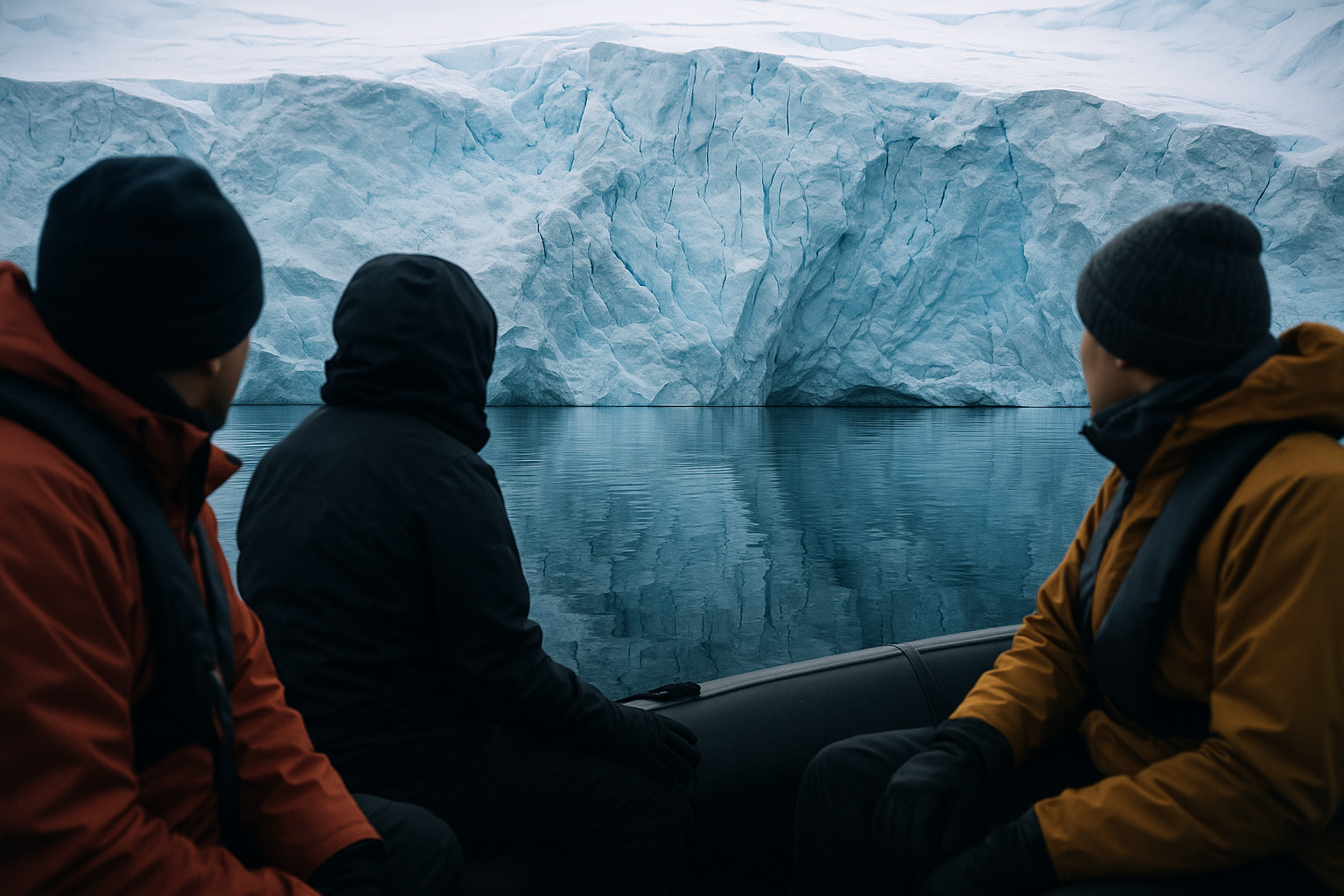
Fair warning about Antarctica: you will smell a gentoo penguin colony well before you see it, and it will permanently change how you tell this story at dinner parties. In the Galápagos, the wildlife never got the memo that humans are supposed to be frightening, so it simply carries on its business a few feet from your boots. Evenings end with a recap in the lounge, where a naturalist explains what you saw today with the energy of someone who has waited their entire life for you to ask about krill.
Compare that to a megaship sea day, where the headline event is a napkin-folding demonstration. Different sport entirely.
Who this actually fits
Solo travelers. Expedition ships run on shared purpose — you eat dinner with the glaciologist, the retired surgeon, and the couple from Perth, and by day three you have a crew. Nobody is solo in a zodiac. The Travel Advisor Pulse survey flagged solos as one of the category's biggest openings, and every solo client I've sent has come home annoyingly evangelical.
Families. A teenager who cannot be surgically separated from a phone will drop it — voluntarily, without negotiation — for a breaching humpback. I have witnessed this miracle. Twice.
Confirmed non-cruisers. You, probably, if you've read this far.
And the honest tradeoff, because this column doesn't do brochure-speak: if your ideal sea day is a swim-up bar, a nap, and a second, more committed nap, this is not your trip, and there's zero shame in that. Expedition days start early, the weather gets a vote on your plans, and crossing the Drake Passage to Antarctica is either mercifully flat or an amusement ride with no exit row. Know thyself. That's the whole game.
The frontier is moving — and filling
The same survey named Japan the next expedition frontier, and that tracks: drift ice off the Shiretoko Peninsula, small coastal ports the big ships physically cannot enter, a shoreline that seems designed for a 150-passenger vessel. Meanwhile the classics keep growing. Swan Hellenic just posted a record July. Antarctica gains new capacity with the Terra Nova Adventurer arriving for the 2026/27 and 2027/28 seasons, and HX is pushing deeper into Greenland, where the icebergs off Ilulissat are the size of civic buildings and roughly as unbothered.

Here's the advisor math: more ships means more choice, but expedition inventory doesn't behave like megaship inventory. A 150-passenger ship sells out by the dozen, not by the thousand — the prime departures and the good cabin categories go to people who decided early, and the leftovers go to people who were "still thinking about it."
If you've said "I don't do cruises" in the past year, you may be exactly who this category was built for — and the difference between the right expedition ship and the wrong one is the difference between the trip of your decade and a very expensive ferry. If this is on your radar, reach out before you lock in the version that looks right but feels off.
🥂 Italy for First-Timers: The Tour, the Mistakes, the Real Cost

Every first trip to Italy begins the same way: a spreadsheet with eleven cities, ten days, and the serene confidence of someone who has never met an Italian regional train on a Sunday.
I've read these spreadsheets. Rome, Florence, Venice, the Amalfi Coast, Cinque Terre, a Tuscan farmhouse "for a night or two," and — my personal favorite — "maybe Sicily if there's time." There is never time. There was never going to be time. Italy doesn't reward skimming. It rewards sitting still long enough to order the second espresso, which is roughly when the country decides it likes you.
Rome, Florence, Venice. Stop.
The classic spine is a cliché because it works. Rome gives you two thousand years of showing off in one walkable sprawl. Florence puts the entire Renaissance within fifteen minutes of your hotel. Venice is the only city on earth that still doesn't quite seem legal. And the high-speed trains connect all three in under two hours a hop — no airports, no rental car, no negotiating a roundabout outside Naples while your spouse narrates.
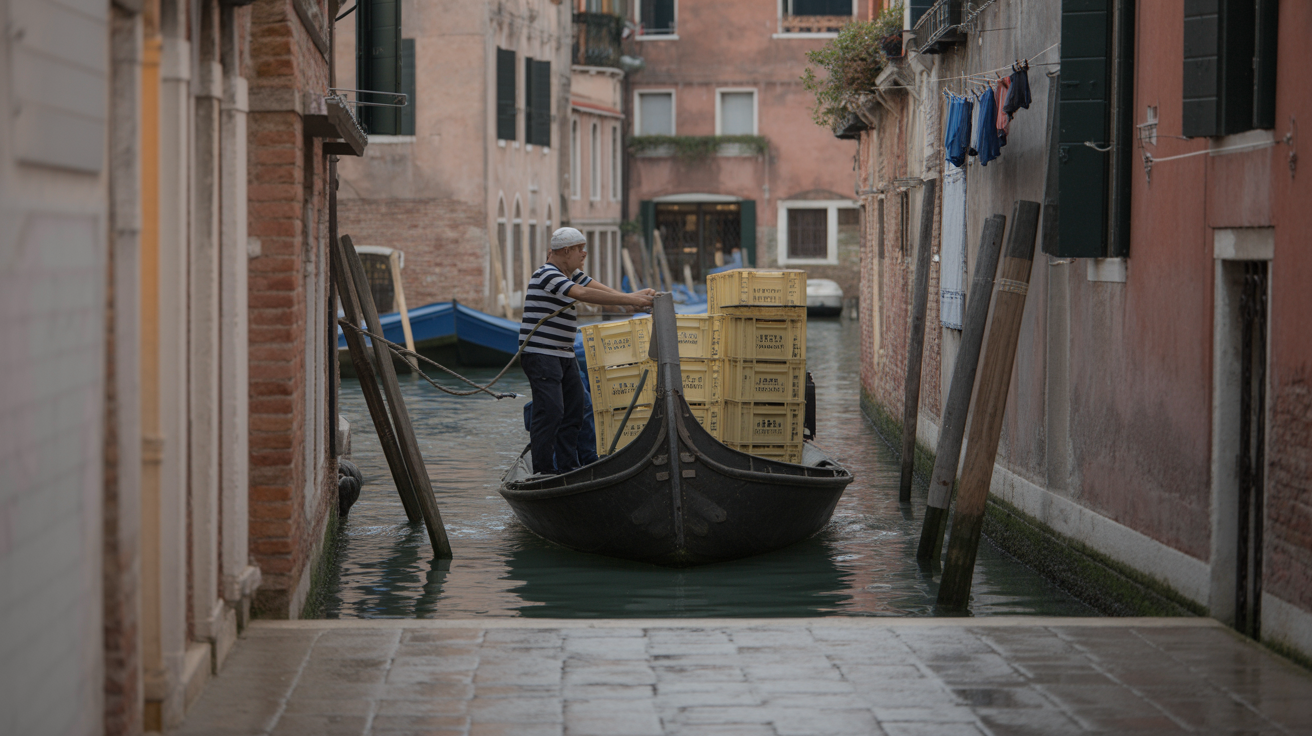
Three cities, nine or ten nights, and margin to breathe. In Rome, that margin looks like a long lunch in Trastevere over cacio e pepe that arrives looking like almost nothing and tastes like the reason the Empire bothered. In Florence, it's skipping the sandwich line at All'Antico Vinaio — good, but it's a line with a snack at the end — and climbing instead to San Miniato al Monte, the church above Piazzale Michelangelo where the monks still sing vespers and the whole city lays itself out below in terracotta, going gold, minding its own business. In Venice, get up before the day-trippers and walk Cannaregio: delivery barges idling at the canal edge, bakers stacking trays, laundry already out over the water, the whole city smelling of coffee and salt and doing its actual job. Then find Cantina Do Mori near the Rialto — pouring wine since 1462 — and eat cicchetti standing up like you've always lived there.
The mistakes are quiet ones
Nobody blows up an Italy trip with one dramatic decision. It leaks.
The rental car for the city spine is mistake one. Italian centers are laced with ZTL zones — camera-enforced limited-traffic areas — and the fines don't stop you at the gate; they arrive by mail, months later, one per camera, like a souvenir subscription you never ordered. Take the train.
Mistake two: assuming you can walk up to the big three. The Uffizi, the Vatican Museums, and the Colosseum run on timed entries that sell out weeks ahead in season. The couple standing outside the Uffizi at 10 a.m., discovering this in real time, is by now a Florentine institution. Don't join it.
Mistake three is August, when the heat is biblical, half of Italy is on its own vacation, and you're paying peak prices to sweat in a queue. And mistake four is eating within sight of the monument — the closer the table sits to the Pantheon, the further the kitchen is from caring.
What it actually costs (and where DIY leaks)
Here's the part the brochures and the DIY blogs both fudge. A guided tour's price looks big because it's honest: hotels, intercity transport, guides, entries, and a chunk of meals in one number. A DIY budget looks small because it's a first draft. The timed entries, the station luggage storage, the city taxes, the Venice water taxi you swore you wouldn't take until you counted the bridges between the vaporetto stop and your hotel — first-timers routinely leak hundreds in line items they never budgeted, plus the vacation days spent being their own logistics department.

The other thing the price tag hides: tier. The tour industry has been consolidating around exactly this — Trafalgar just folded its sister brands into a single house with Saver, Classic, and Premium tiers across 600-plus itineraries — and the tier is mostly buying one thing: location. The budget tier's hotel is fine. It is also, frequently, out by the ring road, which means your "included" trip quietly bills you in taxis and in evenings you didn't get to have. On a first trip to Italy, the walk-out-the-door-into-it hotel is worth real money. That's not an upsell; that's arithmetic.
When the tour wins — and when it doesn't
Honest version. A guided tour wins the first trip on connective tissue: someone else owns the train platforms, the luggage, the timed entries, the guide who turns the Forum into a story instead of rubble. You spend your attention on Italy instead of on Italy's logistics. What you trade is dinner freedom, pace, and the occasional 7 a.m. bags-outside-the-door morning. If a fixed coach seat makes your eye twitch, the answer isn't DIY roulette — it's a small-group departure, or an advisor-built independent trip with the entries and transfers pre-solved, which is the version most of my first-timers end up loving.
And the 2027 shelves are already stocked: Italy specialists like Perillo have opened 2027 Lakes, Wine & Romance itineraries.
On the value side, Globus is running $300–$1,200 per couple off 2027 departures through October 12, and Collette has stackable savings worth up to $1,500 per couple on a booking window that closes September 30.
That matters less as a discount and more as proof: 2027 Italy inventory is open, and the well-located hotel tiers go first. If Italy's on your radar, this fall is the season to talk it through — before you lock in the version that looks right on the spreadsheet and feels off at the ring road.
⭐ The Wayfarer's Favorites (The Deals)
Rates are subject to availability and change until booked. Supplier terms and conditions apply
Six offers survived this week's deadline check. House rule stands: a deal is a fact plus a judgment call, and a price without the judgment is just a number wearing a hat. Booking codes stay on my desk — the offers below are described in full, and when you're ready to move, that's what I'm for.
CIE Tours — Buy One, Fly Two.
Two-for-one companion airfare on 30+ guided and private tours — Ireland, Britain, and newly added Portugal for 2027 — or 10% off land-only, through September 30.
Advisor's Edge: airfare is the line item people forget when comparing tour quotes, and a free second seat moves the total math more than a bigger land discount would. Best fit: couples eyeing Ireland or the new Portugal 2027 departures.
Collette — Stackable 2027 Savings.
Stackable savings up to $1,500 per couple on 2027 departures, with past travelers eligible for up to $2,300 during the pre-sale; the booking windows run mid-to-late September.
Advisor's Edge: "stackable" is doing real work here — the sequencing of which savings apply, and in what order, decides your final number. The past-traveler tier is the actual headline; if you've toured with Collette before, say so before we price anything.
Globus — Freedom to Travel, 2027 Europe.
$300–$1,200 per couple off 2027 itineraries, bookable through October 12.
Advisor's Edge: the dollar figure is nice; the timing is nicer. Booking 2027 Europe now means choosing your itinerary and departure date instead of inheriting whatever's left next spring — which, given this week's deep dive, is rather the point.
AmaWaterways — River, Book by the 15th.
Up to $2,500 per stateroom plus $250 onboard credit on 2026–2028 river sailings, book by September 15.
Advisor's Edge: after a low-water summer, the smart river buy is the season, not just the ship — this offer reaches into 2027 and 2028, which is exactly where the flexible shoulder-date inventory lives. That deadline is real and it is six days after this issue lands.
Celebrity Cruises — Summer Sale II.
Up to 75% off the second guest, plus up to $600 per stateroom in savings and Captain's Club Double Points, with the booking window closing September 21.
Advisor's Edge: second-guest percentage sales reward people who do the division. Compare total sailing price against other dates and lines, never the percentage — 75% off a fare is not 75% off a cruise. Run the math (or hand it to someone who enjoys that sort of thing; hello).
Regent Seven Seas — Free First-Class Air.
Free first-class air plus companion savings of $2,000/$1,500, on bookings made September 1 through October 31.
Advisor's Edge: on far-flung embarkation ports, first-class air is a four-figure line item you'd otherwise pay in cash or comfort. This fits travelers for whom the trip starts at the airport lounge, not the gangway — which, if you read the expedition dive above, may soon be you.
If one of these is circling your kitchen table, reach out before you book — the offer is the starting point, and the fit is the job.
🔎 Quick fine print: Terms, conditions, and availability apply. Offers can change (or sell out) fast—so we’ll always confirm the exact promo and rules for your dates before you book.
🧳 Caught in the Carry-On (Tosh's Takes)
Gate passes are back. The TSA's new Gateside by TSA PreCheck program lets eligible non-flyers through security to greet or see off travelers — a pre-9/11 perk quietly resurrected. Translation: walking your nervous first-time flyer to the gate, or meeting the grandparents as they land, is a real option again at participating airports. Check your airport's eligibility before you promise anyone a gate-side reunion.
Your Global Entry app is getting renamed. On September 15, the Global Entry app becomes the Trusted Traveler app, covering applications and renewals. Your membership isn't changing; the icon on your phone is. If a renewal is coming up, do it in the new app — and don't panic when the old one vanishes.
Cruise-line musical chairs. Princess is swapping Princess Cays for RelaxAway, Half Moon Cay starting November 2026, Carnival is replacing its VIFP loyalty program with Carnival Rewards, and NCL has opened the Great Tides Waterpark on Great Stirrup Cay. If you're loyalty-invested or booked on affected late-2026 itineraries, this is a check-your-booking moment, not a crisis. I can tell you which one you are.
Amex cruise perk deadline. American Express is discontinuing third-party distribution of its Cruise Privileges Program, with changes landing September 15. If your cruise perks flow through an Amex card, confirm how current and pending bookings are affected before that date.
We're still verifying the fine print — ask me before you assume anything.
River levels, without the panic. Low water on the Danube and Rhine disrupted summer itineraries; Riviera paused sales on those rivers aiming to resume around September 13 — no cancellations, revised itineraries, and a no-bus-tour pledge — while Portugal has capped Douro ship numbers. The advisor read: river cruising isn't broken. Specific rivers have specific seasons, and line-by-line low-water policies differ enormously. This is a which-line-and-when question, which happens to be my favorite kind.
📩 Connect & Book
What this work actually looks like, three recent examples, no names:
The couple and the two catalogs. First-time Europe travelers arrived with two dog-eared brochures and one question: Globus or Collette? We ignored the brand names for twenty minutes and counted one-night stops instead. They booked the itinerary with the most two-night stays and the slower mornings — the brand turned out to be the answer to a question they weren't actually asking.
The confirmed non-cruiser. A solo professional who had refused every cruise invitation for a decade wanted wildlife, not waterslides. We skipped the big ships entirely and built a shortlist of small expedition ships where traveling solo is a feature, not a penalty. The objection was never to ships — it was to crowds. Solved.
The seven-day Italy rescue. A family showed up with a self-built itinerary: three cities, seven days, eleven train segments. We rebuilt it around fewer beds and timed museum entries, and the trip stopped being a logistics exam. Same week, similar budget, roughly 100% less sprinting.
Two ways to get your version, and I genuinely don't have a favorite:
Do it yourself — browse and book directly at gnttravelpros.com.
Do it with me — reply to this email and I'll architect it: custom itineraries, group travel, or the complex trips with too many moving parts to trust to a tab bar full of open browser windows.
Places change — hours, menus, and whether a spot still has its magic. Worth a quick confirm before you go, or let me handle the details.
Join the Crew
Prefer to plan it yourself? Search over 13,000 cruises and book your entire trip at gnttravelpros.com 24/7.
Want someone else to handle the logistics? That’s what we’re here for.
Follow along for just enough travel FOMO to finally make you book that trip. Your “Out of Office” reply is waiting!
✨ Win a $10,000 vacation: Choice of a cruise, a Europe journey, or a resort stay. Enter here: https://go.gnttravelpros.com/vacation/deals/promos/contest-enter-to-win. No purchase necessary. See site for full rules.
🛒💻 Prefer to be your own captain? You can browse and book your entire trip yourself, any time — the same deals, on your schedule.
Connect with us:
🌐 Web: gnttravelpros.com
📸 Instagram: @gnttravelpros
👍 Facebook: facebook.com/GNTTravelPros
💼 LinkedIn: GNT Travel Pros - Dream Vacations
▶️ YouTube: @gnttravelpros
📍 Find us on Google: GNT Travel Pros on Google
⭐ Loved working with us? Leave us a Google review
Reach Us:
📞 Text/Call: (954) 220-TRVL (8785)
📅 Schedule a Chat: calendly.com/tjunior-dreamvacations/travel-consult
✉️ Email: tjunior@dreamvacations.com
Happy Wayfaring!
--Tosh R. Junior, CTA | Owner & Head Travel Pro, GNT Travel Pros – Dream Vacations ✈️
Have a trip in mind?
Let's turn this into a plan. A free consultation is the fastest way to get started.
Schedule a Free Consultation